
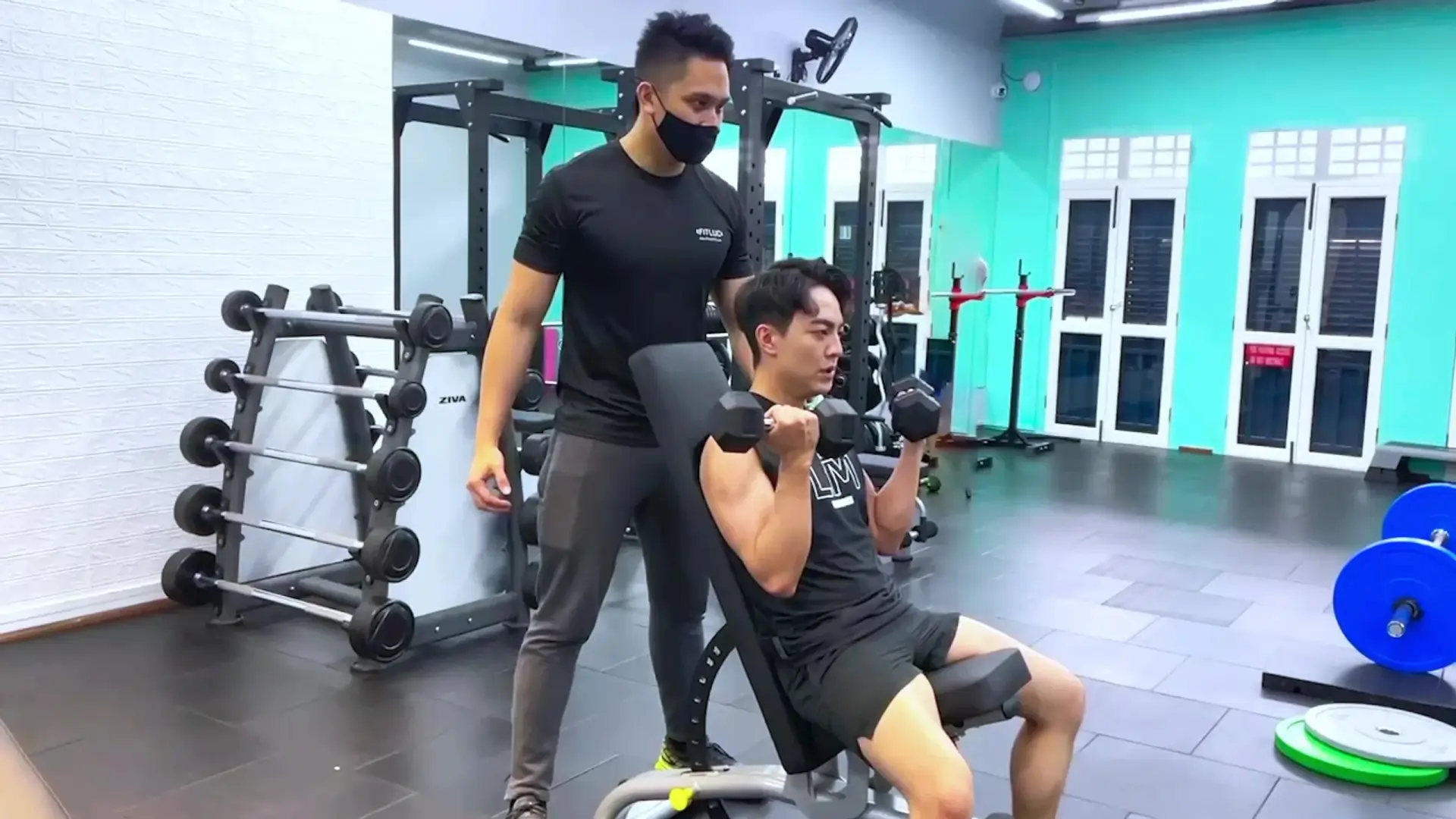

More instruction does not automatically produce better movement. An experienced personal gym trainer singapore clients rely on knows that a technically accurate cue can still be unhelpful when it arrives at the wrong moment or competes with several other instructions.
The purpose of cueing is to change an action, not to display how much the coach knows. When clients receive too many corrections at once, they may slow down, become tense or lose the basic rhythm of the exercise. Effective coaching identifies the most important constraint and gives the smallest amount of information needed to improve it.
Working Memory Is Limited During Exercise
A client performing a loaded squat may already be managing stance, breathing, balance, depth and effort. Adding separate instructions for the knees, hips, chest, elbows, feet and gaze can exceed what the person can process during one repetition.
The result is often mechanical movement. The client tries to satisfy every instruction individually instead of completing one coordinated action.
A good trainer reduces this cognitive load. One cue is given, the client performs several repetitions, and the trainer observes whether it creates the desired change. Additional information is introduced only when necessary.
The Highest-Priority Error Comes First
Not every technical imperfection deserves immediate correction. Trainers need to decide which issue has the greatest effect on safety, comfort or the intended training stimulus.
Suppose a client’s goblet squat shows a small change in toe angle, a mild forward torso lean and a clear shift onto one leg. Correcting all three at once is unlikely to help. The weight shift may be the priority because it changes load distribution and may indicate that the client is avoiding one side.
Once the main issue improves, secondary details can be reassessed. Some may resolve automatically because they were consequences of the original compensation.
Internal and External Cues Produce Different Responses
An internal cue directs attention towards a body part, such as “brace your abdomen” or “squeeze your glutes.” An external cue directs attention towards an outcome, such as “push the floor away” or “drive the handles towards the ceiling.”
Neither category is always superior. The useful choice depends on the client, exercise and problem.
External cues often help clients move more naturally because they focus attention on the task. Internal cues can be valuable when a person needs to recognise a specific position or sensation. A trainer may test both and keep the one that creates the clearest improvement.
Timing Matters as Much as Wording
A cue delivered halfway through a demanding repetition may arrive too late. The client may hear the words but be unable to reorganise the movement while managing the load.
For setup-related problems, the cue should come before the repetition. For rhythm or tempo issues, a brief cue may be repeated during the set. More detailed explanations usually belong between sets, when the client can listen without dividing attention.
This timing keeps the workout moving and prevents lengthy technical lectures from interrupting the training effect.
One Cue Should Be Given Enough Time to Work
Trainers sometimes change cues too quickly. If the client does not respond immediately, the coach may offer several alternative phrases before the person has had time to test the first one.
A better approach is to give the cue, allow a few repetitions and observe the response. Some clients need to experience the movement before the instruction makes sense.
If there is no improvement, the trainer can change the wording or alter the exercise. The important point is to avoid creating a stream of instructions that the client cannot separate or evaluate.
A Cue Cannot Fix a Task That Is Too Difficult
When an exercise is overloaded, excessively complex or poorly matched to the client, verbal instructions have limited value. The person may understand exactly what to do but lack the capacity to do it under the current conditions.
For example, repeated reminders to keep the torso stable will not solve a rowing variation that is too heavy. Reducing the load or adding chest support may immediately improve the movement.
Good coaching therefore combines cueing with programme adjustment. The trainer changes the task when the client’s response shows that words alone are insufficient.
Effective Cues Are Individual
A phrase that works for one client may confuse another. Training history, language, body awareness and previous coaching all influence how an instruction is interpreted.
“Sit back” may improve one person’s squat but cause another to move excessively onto the heels. “Chest up” may help someone maintain position, while another person responds by overextending the lower back.
The trainer must judge the movement produced by the cue rather than assuming that familiar wording is universally correct.
Fatigue Changes What the Client Can Process
A client may respond well to detailed coaching during warm-up sets but need shorter instructions during hard working sets. As effort increases, the ability to process new information usually decreases.
This is why advanced technique work is often introduced before fatigue becomes severe. During challenging sets, the trainer may return to one familiar cue that the client already understands.
If the same fault repeatedly appears under fatigue, the set may need to end. Continuing to add cues while movement quality deteriorates can turn coaching into noise.
Silence Can Be a Coaching Tool
Constant feedback can make clients dependent on the trainer. They may stop evaluating their own movement because they expect a correction after every repetition.
Occasional silence gives the client space to apply what was previously discussed. After the set, the trainer can ask what the client noticed before sharing an observation.
This approach develops self-monitoring. It also helps the trainer learn whether the client understands the movement or is simply responding to continuous prompts.
Coaching Should Produce Transfer
The real test of a cue is whether it improves future repetitions, not merely the repetition during which it was spoken. Useful cues become part of the client’s own preparation and review process.
A client might eventually need only a simple reminder such as “balanced pressure” before a squat or “finish tall” during a hinge. The words carry meaning because they are connected to previous practice.
Coaching environments such as True Fitness Singapore can support this progression by combining guided sessions with opportunities for independent practice. The goal is for instructions to become less frequent as the client’s control improves.
Fewer Cues Create Clearer Accountability
When a trainer gives one specific cue, the result can be assessed. Did the movement improve, remain unchanged or become worse? That answer informs the next coaching decision.
When six instructions are given together, neither the client nor the trainer knows which one affected the outcome. The feedback becomes difficult to use.
Good gym coaching is therefore selective. It prioritises the issue that matters now, delivers a cue the client can act on and then observes the result. Fewer words, used at the right time, often create more durable technical progress.
Comments are closed.